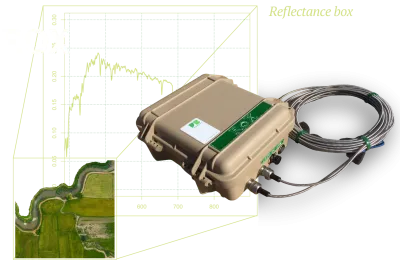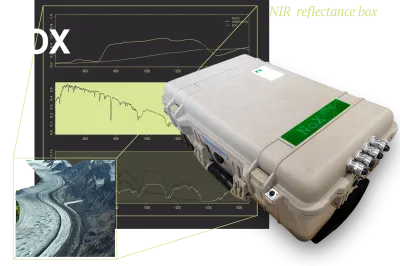
FLOX
Chlorophyll Fluorescence Spectrometer
Description
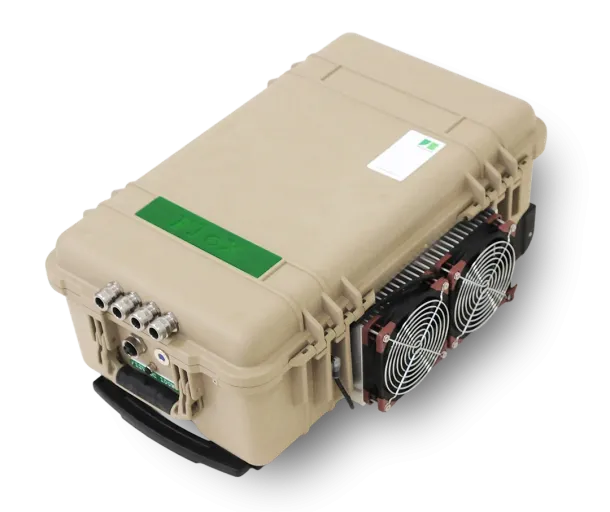
The FLOX chlorophyll fluorescence spectrometer represents the evolution of prototype instruments such as the Multiplexer Radiometer Irradiometer (MRI), SFLUOR box and SIF-System developed from a collaboration between Jülich Research Center and the Remote Sensing of Environmental Dynamics Laboratory of the University Milano Bicocca. The basic routines of the FloX are based on SPECY (Forschungszentrum Jülich, IBG-2: Plant Sciences).
The FloX is specifically designed to measure chlorophyll fluorescence passively under natural light conditions. Therefore, the design is optimized to achieve maximum efficiency in terms of signal to noise ratio, spectral resolution and rapid acquisition time. The core of the system is the QEPro spectrometer from Ocean Optics covering the Red/Near Infrared region (650 – 800 nm). This is the spectral range at which chlorophyll fluorescence is emitted and where the two atmospheric oxygen absorption bands (O2B and O2A, at 689 nm and 760 nm respectively) are used to measure it.
Upward and downward channels of the FloX allow measurement of solar irradiance and reflected radiance from the plant canopy. To maintain a stable level of dark current the spectrometers are embedded in a temperature controlled housing. Signal to noise is maximized due to accurate automatic optimization of the signal in both channels and high performance optical light throughput.
Specifications
OPTIC SPEC 1
-
Wavelength range
650—800 nm
-
Spectral Sampling Interval (SSI)
0.17 nm
-
Spectral resolution (FWHM)
0.3 nm
-
Signal to Noise Ratio (SNR)
1000
-
Field Of View (FOV)
Dual FOV. Upwelling radiance 25°. Downwelling radiance 180°
OPTIC SPEC 2
-
Wavelength range
~ 400–950 nm
-
Spectral Sampling Interval (SSI)
~ 0.65 nm
-
Spectral resolution (FWHM)
~ 1.5 nm
-
Field Of View (FOV)
Dual FOV. Upwelling radiance 25°. Downwelling radiance 180°
OPERATIONAL
-
Signal Optimization
Automatic adaption to varying light conditions
-
Dark current
Accurate dark current determination at each measurement cycle
-
Manual acquisition
Interface software for manual measurement and calibration
-
Automatic acquisition
Fully autonomous measurement mode for unattended data acquisition
-
Quick measurements
20 seconds under bright sunshine 60 seconds in overcast condition
-
Stability
Reference system stability check and uncertainty estimates
-
Simultaneous metadata
Spectrometer temperature, Outside temperature, GPS position, GPS time
-
Data Display
Live assessment of the systems status
-
Data storage
SD card up to 32 GB (12 months of measurements)
-
Case
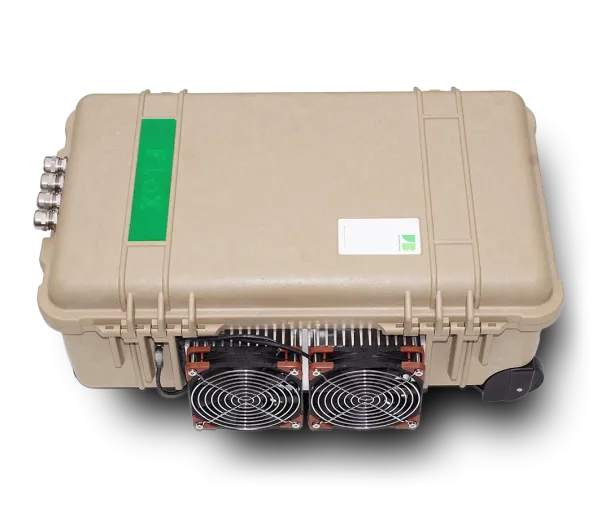
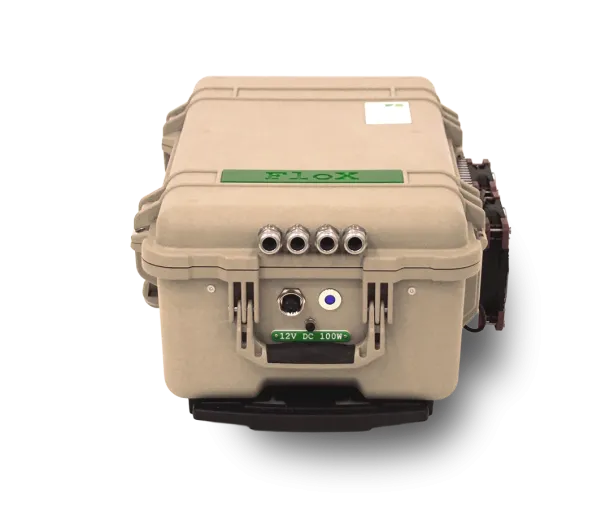
Robust and Waterproof housing based on the 1510 Pelicase
-
Dimension
Small form factor (50 × 30 × 20 cm)
-
Power supply
12 Volt. From battery or solar panels
-
Power consumption
Average consumption of 60 Watt. (20/100 Watt, cooling on/off)
-
Energy saver
Day/night switch for energy saving
-
Interfaces
RS232 via cable and wireless
OPTIONAL
-
Dust Protection
Additional dust protection for Cosine Receptors
-
Fiber optics
Flexible length of fiber optics according to user needs
-
Power supply
Solar panel and battery
-
Communication
Addon for LAN/WLAN/Mobile Network Remote access
FAQ
How can FLOX be integrated for remote access and live data stream?
The basic FLOX is equipped with a USB interface to stream data directly to a connected computer. SDI-12 is also available to stream up to 9 variables real time (VIs, SIF and vital data). An optional embedded PC, if connected to the internet, allows transfer of the full data set collected daily.
Can FLOX be used on a drone?
Don’t even think of it. The basic FloX is rugged, but a fairly heavy instrument that is not designed for airborne use. However, get in touch with us for a glimpse of some secret projects related to airborne deployment.
Can the FLOX be moved easily between measurement sites?
Yes. Checkout the FloX2Go option but be aware that fluorescence measurements require very stable measurement setups and work best in a fixed position.
What is the delivery time of the instrument?
Delivery time ranges from one month to a maximum of three months.
Can Qubit Systems provide assistance for instrument installation?
Yes. Just get in touch with Qubit Systems to request installation services.
Publications
Proximal remote sensing: an essential tool for bridging the gap between high-resolution ecosystem monitoring and global ecology. New Phytologist. 2025.
Zoe Amie Pierrat et.al.
Towards a standardized, ground-based network of hyperspectral measurements: Combining time series from autonomous field spectrometers with Sentinel-2. Remote Sensing of Environment. 2024
Paul Naethe et.al.
SIFFI: Bayesian solar-induced fluorescence retrieval algorithm for remote sensing of vegetation. Remote Sensing of Environment 2025.
Antti Kukkurainen et.al.
DART-based temporal and spatial retrievals of solar-induced chlorophyll fluorescence quantum efficiency from in-situ and airborne crop observations. Remote Sensing of Environment 2025.
Omar Regaieg et.al.
Coupling sun-induced chlorophyll fluorescence (SIF) with soil-plant-atmosphere research (SPAR) chambers to advance applications of SIF for crop stress research. Remote sensing of Environment. 2024.
C.Y. Chang et.al.
Comparing the quantum use efficiency of red and far-red sun-induced fluorescence at leaf and canopy under heat-drought stress. Remote Sensing of Environment 2024.
Sebastian Wieneke et.al.
Identification of an optimal ground-based validation site for FLEX and quantification of uncertainties using airborne HyPlant data-A case study in Italy. Remote Sensing of Environment 2024.
Lena Katharina Jänicke et.al.
Deriving photosystem-level red chlorophyll fluorescence emission by combining leaf chlorophyll content and canopy far-red solar-induced fluorescence: Possibilities and challenges. Remote Sensing of Environment 2024.
Linsheng Wu et.al.
The relationship between wheat yield and sun-induced chlorophyll fluorescence from continuous measurements over the growing season. Remote Sensing of Environment 2023.
Jie Zhu et.al.
WAFER: A new method to retrieve sun-induced fluorescence based on spectral wavelet decompositions. Remote Sensing of Environment 2023.
Veronika Oehl et.al.
The northernmost hyperspectral FLoX sensor dataset for monitoring of high-Arctic tundra vegetation phenology and Sun-Induced Fluorescence (SIF)
Hans Tømmervik et.al.
Empirical insights on the use of sun-induced chlorophyll fluorescence to estimate short-term changes in crop transpiration under controlled water limitation. ISPRS Journal of Photogrammetry and Remote Sensing. 2023
Kazi Rifat Ahmed et.al.
Simulating Global Dynamic Surface Reflectances for Imaging Spectroscopy Spaceborne Missions: LPJ-PROSAIL. Journal of Geophysical Research: Biogeosciences 2023.
Benjamin Poulter et.al.
Contributions of the understory and midstory to total canopy solar-induced chlorophyll fluorescence in a ground-based study in conjunction with seasonal gross primary productivity in a cool-temperate deciduous broadleaf forest. Remote sensing of Environment 2023.
Tomoki Morozumi et.al.
Iterative design of a high light throughput cosine receptor fore optic for unattended proximal remote sensing. Journal of Applied Remote Sensing. 2022.
Andreas Burkart et.al.
Retrieval of chlorophyll fluorescence from a large distance using oxygen absorption bands. Remote Sensing of Environment 2023.
Christiaan van der Tol et.al.
A precise method unaffected by atmospheric reabsorption for ground-based retrieval of red and far-red sun-induced chlorophyll fluorescence. Agricultural and Forest Meteorology 2022.
Paul Naethe et.al.
Harmonizing solar induced fluorescence across spatial scales, instruments, and extraction methods using proximal and airborne remote sensing: A multi-scale study in a soybean field. Remote Sensing of Environment 2022.
Ran Wang et.al.
A novel hybrid machine learning phasor-based approach to retrieve a full set of solar-induced fluorescence metrics and biophysical parameters. Remote Sensing of Environment 2022.
R. Scodellaro et.al.
Physiological dynamics dominate the response of canopy far-red solar-induced fluorescence to herbicide treatment. Agricultural and Forest Meteorology 2022.
Linsheng Wu et.al.
Towards consistent assessments of in situ radiometric measurements for the validation of fluorescence satellite missions. Remote Sensing of Environment 2022.
Bastian Buman et.al.
Remote sensing of sun-induced chlorophyll-a fluorescence in inland and coastal waters: Current state and future prospects. Remote Sensing of Environment 2022.
Remika S.Gupana et.al.
Response times of remote sensing measured sun-induced chlorophyll fluorescence, surface temperature and vegetation indices to evolving soil water limitation in a crop canopy. Remote Sensing of Environment 2022.
A.Damm et.al.
Remote sensing of sun-induced chlorophyll-a fluorescence in inland and coastal waters: Current state and future prospects. Remote Sensing of Environment 2022.
Remika S.Gupana et.al.
Heatwave breaks down the linearity between sun-induced fluorescence and gross primary production. New Phytologist 2021.
David Martini et.al.
NIRVP: A robust structural proxy for sun-induced chlorophyll fluorescence and photosynthesis across scales. Remote Sensing of Environment 2022.
Benjamin Dechant et.al.
Constraining water limitation of photosynthesis in a crop growth model with sun-induced chlorophyll fluorescence. Remote Sensing of Environment, 2021
S.De Cannière et.al.
Downscaling of far-red solar-induced chlorophyll fluorescence of different crops from canopy to leaf level using a diurnal data set acquired by the airborne imaging spectrometer HyPlant. Remote sensing of environment 2021.
Bastian Siegmann et.al.
Practical approaches for normalizing directional solar-induced fluorescence to a standard viewing geometry. Remote Sensing of Environment, 2021
Dalei Hao et.al.
Differential responses in a Mediterranean citrus orchard to two heatwave intensities is identified by combining measurements of fluorescence, carbonyl sulfide (COS), and CO2 uptake. New Phytologist 2021.
Amnon Cochavi et.al.
Assessing the contribution of understory sun-induced chlorophyll fluorescence through 3-D radiative transfer modelling and field data. Remote Sensing of Environment. 2021
A. Hornero et.al.
Concepts and Applications of Chlorophyll Fluorescence: A Remote Sensing Perspective. Geospatial Technologies for Crops and Soils. Springer 2021.
Choudhary K.K. et.al.
Diurnal dynamics of non-photochemical quenching in Arabidopsis npq mutants assessed by solar-induced fluorescence and reflectance measurements in the field. New Phytologist. 2020
K. Acebron et.al.
CloudRoots: integration of advanced instrumental techniques and process modelling of sub-hourly and sub-kilometre land–atmosphere interactions, Biogeosciences. 2020
Vilà-Guerau de Arellano et.al.
Fluorescence Correction Vegetation Index (FCVI): A physically based reflectance index to separate physiological and non-physiological information in far-red sun-induced chlorophyll fluorescence. Remote Sensing of Environment, 2020
Peiqi Yang et.al.
Reduction of structural impacts and distinction of photosynthetic pathways in a global estimation of GPP from space-borne solar-induced chlorophyll fluorescence. Remote Sensing of Environment. 2020
Zhaoying Zhanga et.al.
Unmanned Aerial Systems (UAS)-Based Methods for Solar Induced Chlorophyll Fluorescence (SIF) Retrieval with Non-Imaging Spectrometers: State of the Art. Remote Sensing 2020
Juan Quirós Vargas et.al.
Effects of varying solar-view geometry and canopy structure on solar-induced chlorophyll fluorescence and PRI
K. Biriukova et.al.
Remote sensing of solar-induced chlorophyll fluorescence (SIF) in vegetation: 50 years of progress
G. H.Mohammed et.al.
Diurnal and Seasonal Variations in Chlorophyll Fluorescence Associated with Photosynthesis at Leaf and Canopy Scales. Remote Sensing. 2019
Petya K. E. Campbell et.al.
Sun-induced fluorescence and gross primary productivity during a heat wave. Scientific Reports. volume 8, Article number: 14169 (2018)
G. Wohlfahrt et.al.
A Spectral Fitting Algorithm to Retrieve the Fluorescence Spectrum from Canopy Radiance
Sergio Cogliati et.al.
Sun-Induced Chlorophyll Fluorescence I: Instrumental Considerations for Proximal Spectroradiometers
Javier Pacheco-Labrador et.al.
Sun-Induced Chlorophyll Fluorescence II: Review of Passive Measurement Setups, Protocols, and Their Application at the Leaf to Canopy Level
H. Aasen et.al.
Sun-Induced Chlorophyll Fluorescence III: Benchmarking Retrieval Methods and Sensor Characteristics for Proximal Sensing
M. Pilar Cendrero-Mateo et.al.
An R Package for Field Spectroscopy: From System Characterization to Sun-Induced Chlorophyll Fluorescence Retrieval. 17-19 January 2017, ESA ESRIN, Frascati (Rome), Italy.
Julitta T. Wutzler et.al.
Characterisation of reflectance and chlorophyll fluorescence anisotropy – defining requirements for an experimental setup. Geophysical Research Abstracts, vol. 20, EGU2018-16936, 2018. EGU General Assembly 2018
Biriukova K. et.al.